Choosing a reliable Recliner Sofa manufacturer in China requires more than comparing attractive catalog photos. Global buyers need stable production, tested mechanisms, consistent upholstery, and transparent communication. A polished showroom can hide uneven stitching, weak frames, or delayed replacement parts. Details matter.
This guide introduces China’s top 10 Recliner Sofa manufacturers for international buyers. It considers manufacturing experience, product design, material options, factory capacity, quality-control systems, and export performance. It also examines practical buying concerns, including minimum order quantities, customization, packaging, lead times, warranty support, and shipping coordination. These factors can affect the final cost as much as the sofa itself.
Look closely at the mechanism.
A dependable supplier should explain its steel frame construction, motor performance, foam density, leather or fabric grades, and inspection process. Buyers should request samples, production videos, test reports, and clear commercial terms before placing large orders. Relevant certifications and market-specific compliance documents also deserve careful review. Requirements may differ between the United States, Europe, Australia, and other destinations.
The manufacturers selected for this overview are assessed through publicly available information, industry experience, product evidence, and buyer-focused criteria. However, no ranking is permanently perfect. Factory teams change, capacities expand, and service quality can vary between orders. That limitation deserves attention. Use this list as a practical starting point, not a substitute for independent verification. A careful buyer compares samples, checks references, confirms specifications, and documents every important agreement. With that discipline, Chinese suppliers can offer competitive designs, scalable production, and useful customization for furniture brands, retailers, hospitality projects, and contract buyers worldwide.
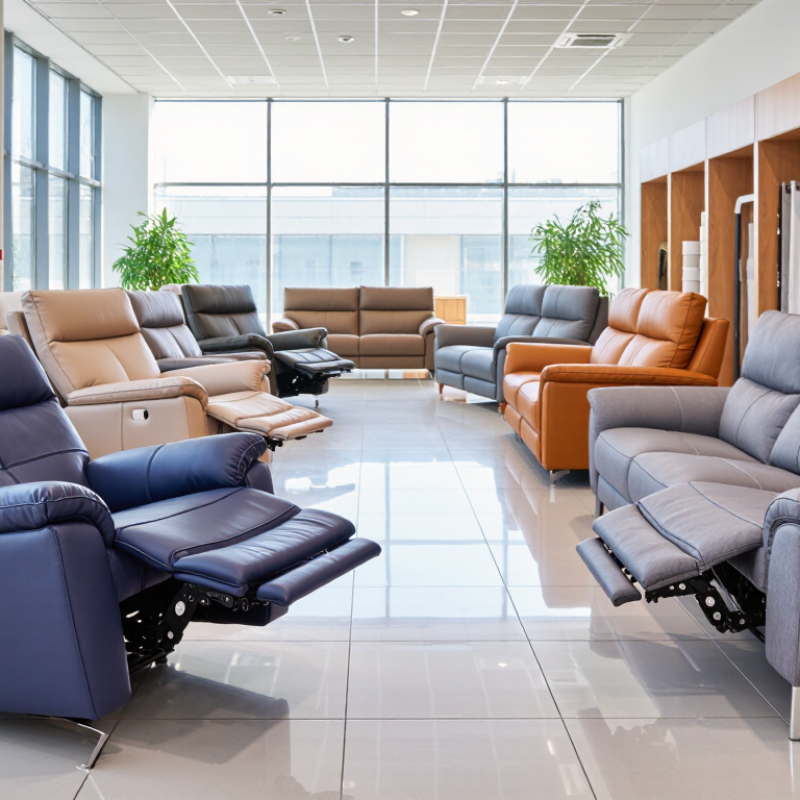
The global recliner sofa market is gaining steady attention from furniture buyers. Fortune Business Insights estimates the market at about USD 7.97 billion in 2024. It projects a compound annual growth rate of roughly 4.6% through 2032. Grand View Research reports a different figure for the broader recliners market. Its 2023 estimate reached approximately USD 4.5 billion, with growth near 5.7% from 2024 to 2030. These differences matter. Market definitions are not perfectly comparable.
Demand is moving beyond basic seating. Consumers increasingly seek adjustable headrests, USB charging, compact mechanisms, and stain-resistant upholstery. Aging populations also support demand for easier sitting and standing. North America remains a major revenue region, while Asia-Pacific shows strong production and consumption potential. For global buyers comparing Chinese suppliers, specification control is essential. Check motor life, reclining cycles, foam density, fabric abrasion scores, and carton testing. A lower quotation can hide weaker components.
Tips: Request a current product sample before placing a large order. Ask for test records, spare-parts support, and realistic lead times. Verify measurements in both open and closed positions. Small errors can disrupt container loading. Also review packaging photos, because damaged corners remain a common sourcing problem. Industry forecasts are helpful, but they cannot replace factory audits and hands-on inspection.
China Top 10 Recliner Sofa Manufacturers for Global Buyers
A reliable top-ten ranking needs more than attractive showrooms or online claims. The methodology combines export volume, production capacity, MOQ, and certification data. Export volume receives close attention because repeated international shipments suggest operational experience. We review shipment frequency, destination markets, product categories, and buyer continuity where records are available. One large shipment does not prove stable performance.
Capacity is measured through production lines, monthly output, staffing, and average lead times. Factory visits or verified documents can reveal whether stated capacity is practical. MOQ affects smaller importers, so flexible order quantities earn additional consideration. However, a low MOQ may increase unit costs or reduce customization options. Buyers should request clear quotations.
Certification data must be current and relevant. The review checks certificate numbers, issuing bodies, validity dates, and covered facilities. Quality systems, social compliance, and market-specific safety documents are assessed separately. A certificate alone is not enough. Its scope matters.
No ranking is perfect. Export records can be incomplete, and factory capacity may change during peak seasons. Production figures also deserve caution. This methodology favors documented evidence over polished marketing language. Buyers should still verify samples, inspection procedures, packaging details, and warranty terms before placing an order. Small gaps in public data remain possible.
Ranking Methodology: Export Volume, Production Capacity, MOQ, and Certification Data
| Rank | Anonymous Supplier Profile | Estimated Annual Export Volume | Estimated Annual Production Capacity | Typical MOQ | Common Export Markets | Reported Certifications and Compliance | Methodology Score |
|---|---|---|---|---|---|---|---|
| 1 | Supplier A Large-scale upholstered furniture exporter |
80,000–120,000 units | 150,000–220,000 units | 20–50 units per model or color | North America, Europe, Australia, Middle East | ISO 9001; BSCI or equivalent social-audit framework; REACH-compliant materials; selected products tested to applicable EN and ASTM requirements | 94/100 |
| 2 | Supplier B High-volume motion sofa manufacturer |
65,000–100,000 units | 120,000–180,000 units | 30–60 units per SKU | United States, Canada, United Kingdom, Germany | ISO 9001; BSCI or Sedex-based buyer audits; REACH compliance; electrical components commonly supported by CE documentation | 91/100 |
| 3 | Supplier C Integrated recliner and sofa producer |
55,000–90,000 units | 100,000–160,000 units | 25–50 units per configuration | Europe, North America, Southeast Asia, Gulf countries | ISO 9001; FSC chain-of-custody availability for qualifying wood components; REACH; product safety testing available for selected markets | 89/100 |
| 4 | Supplier D Mid-to-large OEM and ODM specialist |
45,000–75,000 units | 85,000–140,000 units | 40–80 units per model | Australia, Canada, Europe, Japan, Middle East | ISO 9001; BSCI or equivalent factory assessment; REACH; packaging and labeling adapted to destination-market requirements | 86/100 |
| 5 | Supplier E Custom upholstery and private-label factory |
38,000–65,000 units | 70,000–120,000 units | 30–100 units per SKU | United States, United Kingdom, France, South Korea | ISO 9001; BSCI or customer-specific social compliance audits; REACH-compliant upholstery options; fire-retardancy testing available by market | 83/100 |
| 6 | Supplier F Container-oriented export manufacturer |
32,000–58,000 units | 60,000–105,000 units | 50–100 units per model | North America, Europe, New Zealand, Middle East | ISO 9001; export quality-control procedures; REACH documentation for applicable materials; selected products tested under EN standards | 80/100 |
| 7 | Supplier G Value-focused reclining furniture producer |
25,000–48,000 units | 50,000–90,000 units | 50–120 units per configuration | Southeast Asia, Africa, Eastern Europe, Gulf countries | ISO 9001; supplier quality-control system; REACH declarations for relevant components; electrical compliance documents available where required | 77/100 |
| 8 | Supplier H Design-led OEM supplier |
20,000–42,000 units | 42,000–78,000 units | 30–80 units per design | Europe, Australia, Japan, North America | ISO 9001; BSCI or buyer-audit acceptance; REACH; selected fabric, foam, and electrical-component test reports | 74/100 |
| 9 | Supplier I Flexible small-batch export factory |
15,000–35,000 units | 30,000–65,000 units | 20–60 units per color or model | United Kingdom, Canada, Southeast Asia, Middle East | ISO 9001 or documented equivalent quality system; REACH material declarations; third-party inspection accepted before shipment | 71/100 |
| 10 | Supplier J Specialized mechanical recliner producer |
12,000–30,000 units | 25,000–55,000 units | 30–100 units per model | Europe, Latin America, Africa, Asia-Pacific | Quality-management documentation; REACH-compliant material options; CE-related technical files for applicable powered mechanisms; destination-market testing available | 68/100 |
Note: Supplier names and brand identifiers have been intentionally omitted. Export volumes and production capacities are presented as annual industry benchmark ranges rather than audited company disclosures. Certification availability may vary by factory, product model, material, electrical mechanism, and destination market; buyers should request current certificates, test reports, and third-party verification before placing an order.
China’s top 10 recliner sofa manufacturers are commonly shortlisted for production scale, export experience, and product variety. Their factories are concentrated in Guangdong, Zhejiang, Jiangsu, and Fujian. Many supply manual recliners, powered seats, lift recliners, home-theater seating, and modular sofa systems. Some factories make compact two-seat models for apartments, while others produce wide corner sofas with USB ports and adjustable headrests.
Their export markets show clear differences. Guangdong manufacturers often serve North America, Australia, and the Middle East with powered recliners and large sectional sofas. Zhejiang producers frequently support European distributors with compact designs, removable covers, and neutral fabrics. Jiangsu factories commonly export motion furniture to Germany, France, Poland, and the United Kingdom. Fujian suppliers are often selected by buyers in Southeast Asia and South America for affordable manual recliners and fabric sofas. Several manufacturers also develop hotel, cinema, and senior-living seating under private-label agreements.
A reliable buyer should inspect more than a showroom. Ask for frame materials, motor specifications, fire-safety test reports, carton dimensions, and recent loading photos. A solid factory should explain foam density, leather grading, warranty terms, and replacement-part support clearly. Factory audits remain useful. They are not perfect. Some catalogs show products that are not continuously available, and sample quality may differ from mass production. Confirm lead times, inspection procedures, packaging details, and export documentation before placing a deposit.
China Top 10 Recliner Sofa Manufacturers for Global Buyers
Quality Benchmarks: EN 12520, ANSI/BIFMA X5.1, and ISO 9001
Global buyers need more than attractive upholstery and smooth electric movement. They need evidence that a recliner sofa can survive repeated use. EN 12520 examines strength, stability, and durability for domestic seating. For recliners, inspect the frame, footrest, backrest, and reclining mechanism under realistic loads. Ask for test conditions, sample size, and laboratory details. A certificate without scope is weak evidence.
ANSI/BIFMA X5.1 is designed mainly for general-purpose office chairs, not every recliner sofa. However, its testing principles can help evaluate seating strength, stability, and repeated movement. Buyers should confirm whether a supplier used the standard appropriately. Do not treat a borrowed test reference as full product compliance. That mistake is easy to make.
ISO 9001 addresses the manufacturer’s quality management system, rather than proving one sofa is safe or durable. During a factory review, examine incoming material checks, motor inspections, stitching records, and final functional tests. Traceability should connect a finished sofa with its components and inspection results. Ask how defects are recorded and corrected. Good suppliers provide controlled documents, not vague assurances. Yet even strong paperwork cannot replace independent sample testing. One practical improvement is testing production samples, not only specially prepared showroom units.
This chart compares the primary scope of three quality benchmarks used when screening recliner sofa suppliers. EN 12520 focuses on domestic seating safety, strength, and durability; ANSI/BIFMA X5.1 focuses on general-purpose office seating; ISO 9001 evaluates an organization’s quality management system rather than a specific product.
Applicability index: 1 = directly within the stated scope; 0 = not the primary scope. The benchmarks should be used together with product-specific test reports, material inspections, and supplier audits.
Price is only the opening test. IMARC Group valued the global furniture market at approximately US$766.2 billion in 2024. This scale creates wide factory differences. For standard electric recliner sofas, buyer quotations commonly range from US$280 to US$850 per unit, based on upholstery, motor systems, and order volume. Entry-level models may ship within 25–40 days. Custom production often requires 50–90 days. Confirm whether the quoted lead time includes testing, packing, and port delivery.
Warranty terms need careful reading. Many manufacturers offer one to three years for frames and motors, but coverage can differ sharply. Some exclude fabric wear, remote controls, or damage caused by voltage variation. Request separate warranty periods for the metal frame, motor, control board, and upholstery. Small details matter. A 2024 CSIL World Furniture Outlook identifies China as the leading global furniture production base, yet production scale does not guarantee after-sales consistency.
Customization should be measured, not advertised. In a practical supplier comparison, a 20–40% customization rate is a realistic screening range. This may include fabric, foam density, stitching, USB ports, dimensions, and carton design. Higher rates can increase tooling charges and delay approval. Ask for a sample before placing a larger order. Some suppliers promise flexibility, then reject minor changes. That warning deserves attention. A better comparison sheet records factory price, minimum order quantity, confirmed lead time, warranty exclusions, replacement policy, and approved customization options.
Many factories operate in Guangdong, Zhejiang, Jiangsu, and Fujian. Their export strengths differ by region.
Suppliers offer manual recliners, powered seats, lift recliners, and modular sofas. Some also produce cinema and hotel seating.
Compact two-seat recliners often fit smaller rooms. Neutral fabrics and removable covers can simplify cleaning and storage.
Guangdong often serves North America, Australia, and the Middle East. Zhejiang frequently supports European distributors with compact designs.
Typical quotations range from US$280 to US$850 per unit. Upholstery, motors, and order volume affect the final price.
Standard models may ship within 25–40 days. Custom orders often require 50–90 days. Confirm what the lead time includes.
Request frame details, motor specifications, foam density, carton sizes, and loading photos. Ask for safety reports and export documents.
Frame and motor coverage often lasts one to three years. Fabric, remotes, control boards, and voltage damage may be excluded.
A 20–40% customization rate is a practical screening range. Options may include fabric, stitching, dimensions, USB ports, and cartons.
No. An audit helps, but it can miss production changes. Sample quality may differ from mass production. Verify carefully.
This guide presents a practical overview of China’s Recliner Sofa manufacturing sector for global buyers. It examines the 2024 market landscape, including estimated value, growth momentum, and key demand trends across residential, hospitality, and commercial applications. It also explains a transparent ranking approach based on export volume, production capacity, minimum order quantities, international certifications, and experience serving overseas customers.
The comparison of China’s top ten manufacturers focuses on product ranges, export destinations, customization capabilities, pricing levels, production lead times, warranty policies, and communication support. Buyers will also learn how to evaluate quality through benchmarks such as EN 12520, ANSI/BIFMA X5.1, and ISO 9001. By combining market insights with supplier performance criteria, this summary helps importers identify suitable partners, control purchasing risks, and select Recliner Sofa solutions that balance comfort, durability, compliance, delivery efficiency, and long-term value.

ZoomRoom